I Don’t Believe In The Stars
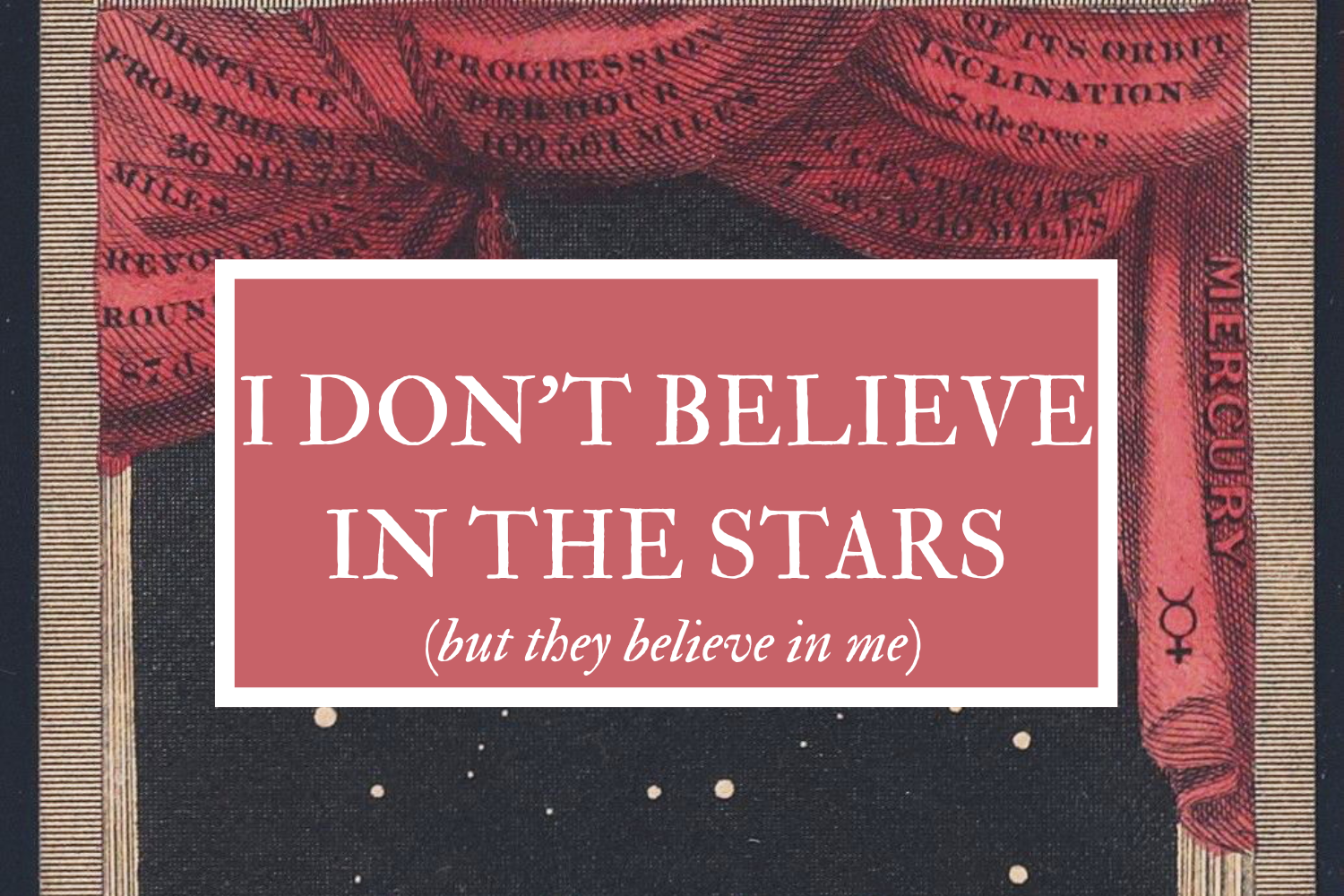
Astrology is dismissed as pseudoscience. Yet most of us can name our sign faster than our blood type. As Mercury slips into retrograde this March, our editor-in-chief examines why, even in an age of data and disbelief, we still search the sky for ourselves.
Personally, I believe in deadlines. In education. In CV lines stacking neatly one beneath another. I collect qualifications the way other people collect festival wristbands. My calendar looks like a game of Tetris played by someone terrified of empty space. There is always a project, a deadline, a next ascent. In short: I am a textbook Capricorn. My ascendant is Scorpio, which gives the diligence a sting. My Chinese zodiac sign is the Monkey, which means I can occasionally be funny about it. A workhorse with a punchline. A planner with plausible mischief.
I have always loved astrology. This is largely the fault of a mildly unhinged uncle who could read a birth chart the way other people read train timetables. He would peer at a wheel of houses and planets and calmly announce that a betrayal was imminent, or that a foreign move would reorder everything. He never raised his voice. The certainty did the work. It was theatre. But persuasive theatre. Despite the early missionairy work, I still insist it’s hogwash. I am educated: I believe in data, in footnotes, in peer review. And yet the stars have an unnerving habit of describing me.
Astrology’s renaissance fascinates me because it thrives in contradiction. We are a generation that treats scepticism as hygiene. We fact-check. We cross-reference. We debunk. But we also know our moon signs.
Case in point: At a house party many moons ago — appropriately enough — a cluster of guests began smashing wine glasses in my friend’s sink. Burgundy pooled. Crystal splintered. The noise was performative, almost jubilant.
I watched with anthropological detachment. Annoying, yes. Civilisational collapse, no. A friend reacted differently. She stiffened, then flared. Within seconds she had crossed the kitchen, voice sharpened into command. Stop. Put it down. Get out. She was incandescent — not because of the glasses, but because of the injustice of it. The casual vandalism in a place they had been welcomed to with open arms. I leaned over and asked, quietly, “Are you a Libra?” She froze mid-rant. “How did you know?” she demanded, suddenly more shocked by my question than the shards of crystal.
Because you can’t cope with injustice,” I replied. “Your reaction is classic Libra.” She had always dismissed astrology as fluff. And yet there she was, momentarily disarmed by it. Not converted. Exposed. You could call it projection. Probability. Confirmation bias wearing a sequinned cape. You would be right. But the sky is wider than that.
Long before astrology was reduced to glossy sidebars and dating-app shorthand, it was scholarship. The Babylonians charted planetary movements as early as the second millennium B.C., mapping the heavens to forecast earthly events. The Greeks formalised the zodiac; Ptolemy’s Tetrabiblos systematised astrological thought in the 2nd century. In medieval Europe, astrology was taught alongside medicine and astronomy; physicians cast charts to diagnose illness. Kings employed court astrologers. The boundary between science and mysticism was porous. Indeed, astronomy and astrology were once twins. It was only with the Enlightenment, with telescopes, empiricism and the eventual triumph of Newtonian physics, that the siblings split. One kept the lab; the other inherited the myth.
Of course, astrology did not confine itself to harvests and wars. It governed love. Royal marriages were timed according to planetary alignments; compatibility was assessed not only by lineage but by the heavens. Medieval European nobles consulted astrologers before betrothals, anxious that Mars might inflame a union or Venus fail to bless it. In parts of South Asia, astrological matching still remains integral to arranged marriages, with charts compared to ensure harmony between families and futures. Love, that most irrational of human impulses, has long sought celestial reassurance.
We call the divorce of astrology from science progress. But progress can amputate as well as refine. For most of human history, looking upward and finding meaning there was not naïve. It was necessary. Astrology was an early technology of reassurance, a way to insist that catastrophe had context, that desire had design, that even romance obeyed rhythm. We flatter ourselves that we have outgrown such needs. Today, we have markets, metrics, machine learning. We have therapy-speak, psychometrics, personality inventories with copyright symbols. We can quantify attachment styles and optimise morning routines. And still, astrology returns.
In a world governed by opaque algorithms, astrology is at least legible. You can learn it. Your birth chart is yours. It does not change according to shareholder interest. It offers a fixed myth in a fluid age.
Astrology is low-stakes transcendence. It asks for curiosity, not conversion. You can dip in and out. You can laugh at it and consult it in the same breath. It offers cosmic significance without moral obligation. This is not stupidity. It is displacement. Because there is something less charming beneath it. Astrology absolves. If my ambition is Saturn’s doing, it is destiny, not compulsion. If my temper is Mars, it is placement, not pattern. If my relationships implode, perhaps the charts were misaligned from the start. The cosmos becomes scapegoat. For a generation fluent in self-optimisation, astrology performs a subtler seduction: It describes rather than demands. It names you without asking you to change. In a culture obsessed with reinvention, that feels merciful.
Yet we should remain mindful that mercy can calcify. If everything is written in the stars, nothing is my fault. So no, I don’t believe in the stars.
I do not imagine Jupiter micromanaging my inbox. I do not think Mercury sabotages my emails.
But I understand the appeal: the relief of believing our traits are placements rather than choices. That our chaos has choreography. That even our romantic misfires might have been forecast somewhere ancient and dust-lined. We look upward not for proof, nor even for prediction. We look for permission. Permission to be as we are. Permission not to untangle ourselves. Permission to call inertia identity.
Astrology endures because it answers a question science was never designed to solve. Not: How does the universe work? But: Who am I allowed to be within it? And that question — however sceptical, however literate we claim to be — still has us glancing at the sky.
This article originally appeared in Issue 03, published in March 2026. It was published online on May 14, 2026.