Jini Rawlings
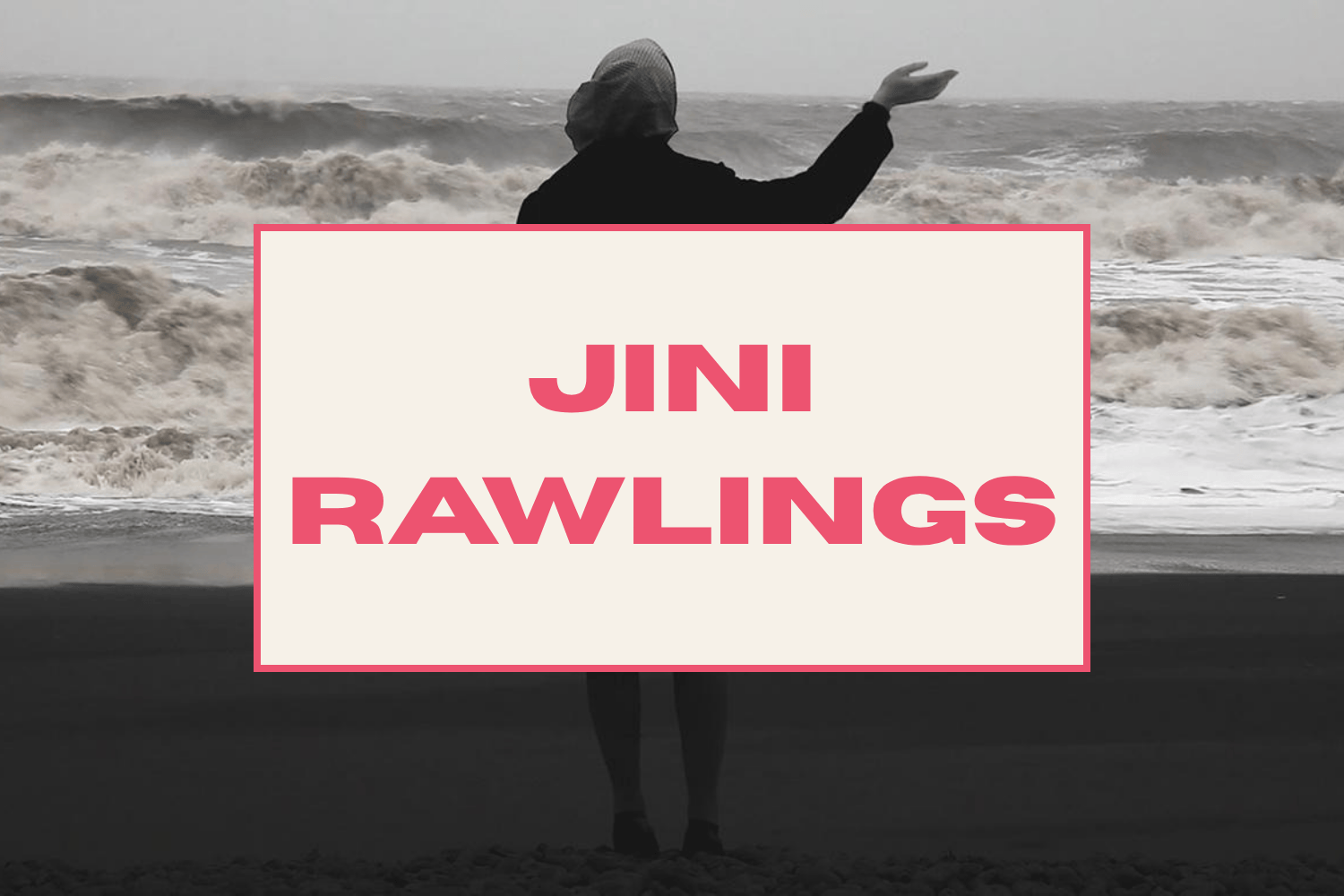
WAVE/ING (2012) by Jini Rawlings
What happens when personal history fractures? We spoke to multi-screen, mixed-media artist and academic Jini Rawlings, whose installations weave journeys, archival fragments, and liminal spaces into immersive explorations of memory, identity, and the stories left untold.
The first thing Jini Rawlings learned about herself was wrong. She was well into adulthood when she discovered, by chance, that she had been adopted. The revelation didn’t just upend her personal narrative; it created the conditions for a kaleidoscopic, almost fifty-year body of work. “As Pierre Janet says, Every Life is a Piece of Art, put together with all means available,” she reflects, describing how trauma informs her practice without defining it. Her work continues to explore pressing social and cultural themes — forced migration, feminism, displacement, postcolonialism — while remaining deeply personal, intimate, and humane.
To meet Rawlings in person is to sense acute attentiveness: alert, almost childlike in focus, she moves as if listening for something just beyond ordinary perception. Her installations, however, are anything but hidden. Meticulous and layered, they fuse history, memory, and emotion in ways that resist being “decoded,” inviting viewers instead to inhabit their spaces and narratives.
Indeed, it is impossible to summarise Rawlings’ extensive career in a short article, yet even a cursory glance reveals a clear before-and-after. Her early work was grounded, like many of her peers, in documentary photography and feminist critique. Particularly formative was her involvement with the Hackney Flashers, London’s feminist photography collective, and her collaboration with Jo Spence. These experiences shaped her understanding of power, authorship, and representation. “Who holds the baby? Who controls the story?” she asks. In Prosperity Street, a black-and-white series created in a Leeds neighbourhood facing demolition, she photographed residents in ordinary moments: a mother cradling her child, women in domestic interiors. At the time, she could not have known how resonant these images would become. Decades later, they read almost as premonitions — early meditations on care, maternal presence, and loss that resurface in Dear Child (2017/18) and Shattered Silk (2022/23). Later, feminist video workshops — including Waves and Reel Women — expanded her commitment to collective storytelling, sharpening her awareness of whose voices are amplified and whose are erased, an ethos that continues to underpin her work today.
The discovery of her adoption reframed these concerns with profound urgency. What she had long taken for memory turned out to be inference; what felt like inheritance was, in part, absence. “A bouleversement,” she calls it, a seismic overturning of everything she thought she knew. Half-remembered phrases, fleeting encounters, family anecdotes all shifted into new alignments. “It was like tectonic plates moving beneath the surface of my life,” she explains. From that moment on, Rawlings’ work would dwell in fragments, gaps, and reverberations: the very conditions through which she had come to know herself.
With the shift she began to use archives as both tool and companion. Birth records, census returns, death certificates: Each document offered evidence and provocation. “By chance, I doorstepped a birth uncle after finding my grandfather’s death records,” she recalls. “I saw a photograph of my mother for the first time. Suddenly, a biological mirror.” The encounter was grounding and disorienting in equal measure, reinforcing her sense that identity is assembled through partial access. It is thus unsurprising that maternal absence and intergenerational connection recur throughout her installations.
Historical women, from Lakshmi Bai, Rani of Jhansi to silk weaver Sarah Fletcher, become, in Rawlings’ words, “the mothers I never had.” Through them, she explores outsiderdom, resilience, and reinvention. In Dear Child, asynchronous video loops evoke Montagu’s daughter, unseen for twenty years, creating a space in which absence is itself palpable.
Rawlings’ own lineage is equally present. During a residency at the National Maritime Museum, where she was the first artist-in-residence, she traced an ancestor who sailed to India with the East India Company in 1858, embedding her family history within broader narratives of colonial expansion, migration, and subaltern labour. “I am fascinated by the small hints in archives,” she says. “They reveal different ways of looking at histories.” Borrowing from Gaston Bachelard, Rawlings speaks of poetic reverberation, the way meaning emerges through encounters between subject and object, past and present. Resisting closure, her work instead enacts what she calls “critical fabulation,” blending archival fact with imaginative reconstruction so that history is experienced as lived and contingent, rather than fixed.

Amy Emily Emma by Jini Rawlings. Photo credit: Jim Stephenson
As a multidisciplinary, mixed-media artist, Rawlings treats material choices as inseparable from her narrative. Silk, glass, and video recur across works such as WAVE/ING, CUSP, and Shattered Silk. Fragile and semi-transparent, they register touch, reflection, and vulnerability. Costumes, hand-sewn and interactive, alongside projections of dancers improvising on archival traces, transform documentation into living, speculative storytelling. “Because I never grew up with these stories,” she explains, “they are almost characters. I can choose fragments, suggest meanings, and allow them to remain unresolved.” Objects, too, play a vital role. Photographs and semi-coated glass panels function as stand-ins for what cannot be fully known. In She Had No Sense of Perspective (2025), Rawlings pairs her mother’s photographs with her own, revealing mirrored gestures across time. “It’s both a fabulation and a form of grounding,” she says — “an inhabitation of the past with enough distance to survive it.”
Looking ahead, Rawlings has no intention of slowing down. Her practice continues to interrogate adoption, displacement, and migration through an intersectional lens, weaving personal history with postcolonial and ecological concerns. New works explore the womb and the abyss — the ocean as a site of loss, passage, and potential rebirth.
For those in London, Rawlings will open her studio this April — a rare chance to experience these layered histories in the very space where fragments become whole. Visitors can see how personal and collective memory, absence and presence, intertwine in immersive installations, objects, and spatial storytelling. It is an invitation to step inside the intimate architecture of memory and witness, in real time, the transformative power of imaginative engagement.
Yet ultimately, meaning in Rawlings’ work is never imposed; it emerges between artwork and viewer. “I want people to navigate the work on their own terms,” she says, “to find echoes of their own disruptions, and perhaps a sense of permission to reimagine themselves.”
Rawlings is currently developing new work, set to be unveiled this June. For a deeper dive into her practice, see jinirawlings.co.uk.
To experience her work in person, visit her during her open studio from 24-25 April at Artist Studio Company (ASC), 246 Stockwell Road, SW9 9SP, London.
This article originally appeared in Issue 02, published in February 2026. It was published online on April 11, 2026.