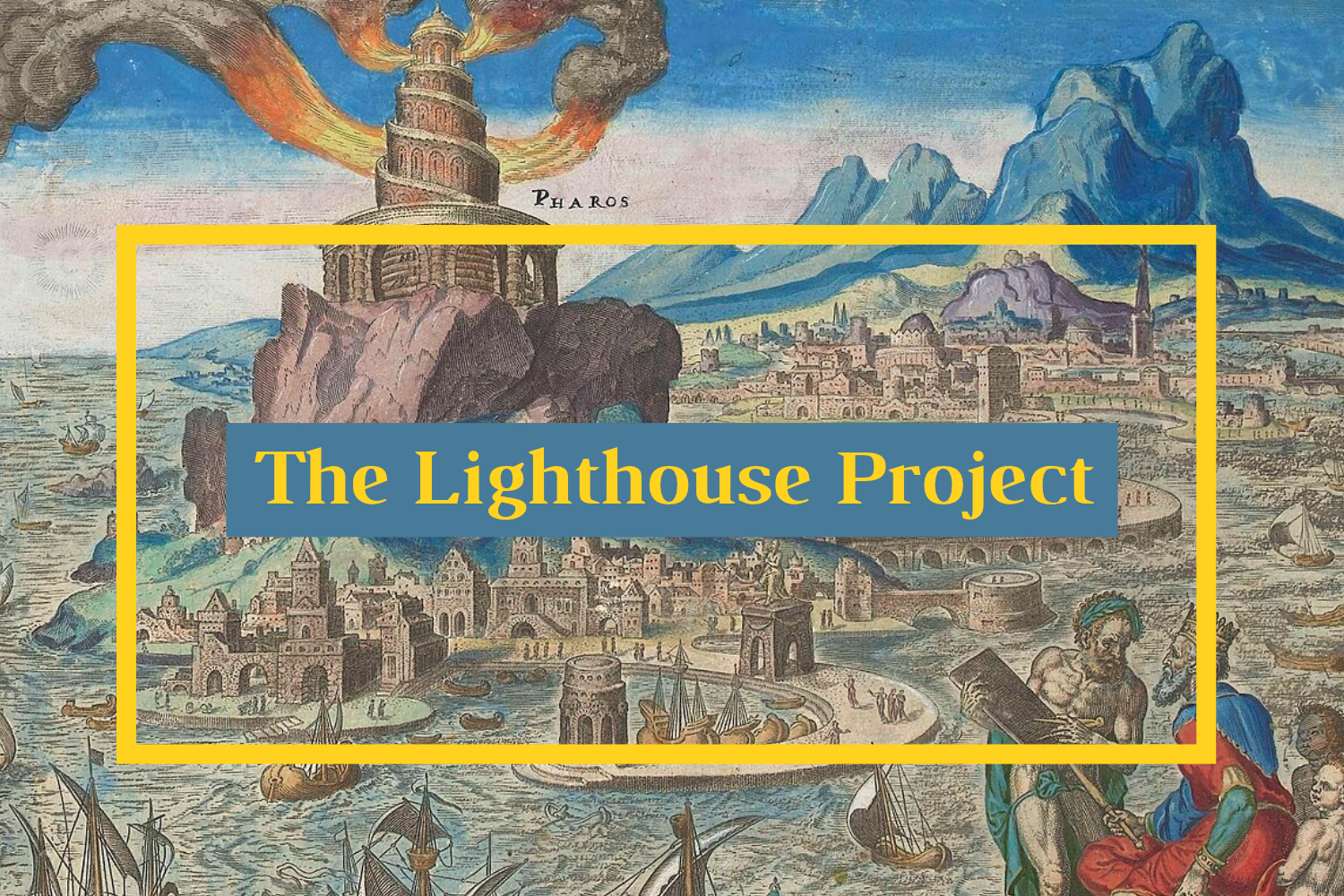
The Pharos of Alexandria is said to have been the first lighthouse in the world. Standing more than 440 feet tall, it survived for some 1,500 years before earthquakes finally brought it down. One of the Seven Wonders of the Ancient World, its purpose was simple: to cast light into the darkness for strangers trying to find their way home. Nearly 2,000 years later, Australian musician Luke Saunders has built a different kind of lighthouse, yet one designed to do much the same thing. Saunders sends handwritten poems to strangers anywhere in the world. They are free. There is no subscription, no catch, and no obligation to give anything back. “One small act of radical generosity,” he explains. “A free, handwritten poem for every soul who seeks a little light.” He calls it “The Lighthouse Project.” In his Sydney studio, Saunders is building a map of the world, marking every place a poem has travelled. So far, he has written 306 poems to people in 64 countries. Each poem becomes a star: numbered, archived, and remembered. “No one is forgotten in the Lighthouse Project,” he says. “I want to document everything.”
For all its generosity, the project began with perhaps the most private form of solitude: grief. In 2024, Saunders lost a friend who “disappeared abruptly.” In the aftermath, he wrote a song imagining they had been given one more day together. “This is your Lighthouse Song, this is all we’ve got,” he wrote. The song became a way of imagining that perhaps the people we lose do not disappear completely. “I suppose we can live together eternally inside the Lighthouse Song,” he dreams. Saunders wanted to honour his friend, but also people who had become consumed by loneliness. Rather than asking strangers online for their attention, he wondered what it might mean to give them his. “I have paper, ink, and time,” he says. “And a heart willing to hear your story and tell you that you matter.” The gesture may sound grand yet the process is remarkably simple. A person sends Saunders their story. He sits down with a piece of paper and writes a poem by hand. When it’s finished, he sends the poem back to them — either digitally, or, if they want to receive it by post and are comfortable sharing their address, in a handwritten letter.
Nothing about the exchange is optimised, which is precisely the point Saunders is trying to make. “Attention is not a currency, attention is love,” he exclaims. He is adamant to ensure that the core of his message is understood: “A lover telling you they like your hat is one thing,” he explains. “A stranger stopping you in the street to say it is another. The stranger has no obligation to notice you.” Which is exactly what he wants his poems to offer: “You do not have to pay to be seen, and you do not have to pay to be a human being.” Saunders could have, of course, made the project entirely digital and instant, yet he believes the rise of artificial intelligence and endless digital content is only making the human act of making something more valuable. The imperfections of human work, the time it takes, the mistakes, the physical evidence of a person having made something, become more meaningful precisely because machines can increasingly produce things instantly. “Whatever the contents of the poem are, it’s a magical feeling to see the curve of the letters and the imperfections and scribbles that someone has put their mind and heart towards: acknowledging that you matter.” Despite the lack of algorithmic optimisation, his poems are available anywhere, from Pakistan to South Korea to Martinique.
The poems may begin with Saunders, but they rarely end there. People write back, send things, make art, and add their own mark to the archive. He has begun thinking of those responses as another kind of light. The Star Map records where his poems have travelled: light landing in the world. The Cascade Map records what comes back. “Anytime I receive a letter, painting, or poem it’s truly incredible, and I mark on the map where the light has travelled,” he says. One reader had fled Sudan and was seeking refuge in Saudi Arabia and sent Saunders a poem in which the lighthouse became a symbol of hope in dark times. A woman listened to “Lighthouse Song” while crying and dancing in the rain because it reminded her of her brother. Another had lost her son five years earlier. They shared the same initials, and her son had also been a musician. “It’s an incredible process,” he says. “To write someone a poem – they listen to my music – they are moved by this experience – they reflect it back to me in the form of art.” At the moment, Saunders is learning calligraphy to make the poems even more considered. People have sent him paper, envelopes, and brush pens; his favourite is a Tombow Fudenosuke. Someone in Spain is going through the trouble of sending him a lighthouse wax stamp. Asked how readers can give back, Saunders doesn't ask for money. He asks for kindness, attention, and whatever someone feels moved to make. “I cannot solve world loneliness,” he says. “Yet a lighthouse shines consistently on the ocean every night.” For someone seeking refuge in the harbour, the light is simply there. He intends to keep it that way. That is why the poems will always be free. Before the poems, Saunders was writing songs about many of the same things: grief, purpose, loss, and hope. He describes his music as the “philosophical nucleus” of The Lighthouse Project.
Ultimately, however, the project is not really about poetry. Nor is it about music. It is about being witnessed. His long-term vision is an interactive website where every poem is recorded and catalogued on a global Star Map. Each person who receives one would have their own light. One day, he imagines, there could be 10,000 poems and 10,000 lights. “This is anti-algorithmic and anti feed,” he says. “It’s memory. It’s an archive of human resonance.” Saunders sees the physical archive as an antidote to the disposable nature of the modern world. Rather than being built around an endless present; the Lighthouse is interested in meticulous preservation. “Memory is important and is the antithesis of modern social media,” he explains. He imagines eventually taking the project on tour. At his shows, people could bring poems to the Lighthouse Box and leave with one written for someone else. The box would travel from city to city, carrying poems between strangers. Recipients could upload them to their Lighthouse Keeper profiles and watch their own stars appear on the map. “I want people to feel connected to each other, not just connected to Luke. I want people to feel connected to the Lighthouse as a philosophy.” The ambition is almost utopian, yet the mechanism is remarkably small. A piece of paper. Some ink. A stranger willing to tell another stranger something true.
Saunders recently learned that his own name has a connection to the idea of light. Someone he wrote a poem for in London told him about the traditional association between Luke and “light.” He calls the discovery an “enlightening moment,” to say the least. But his understanding of his project has only become more nuanced as it progresses. “There are forces of good and evil at play in every system on Earth. We just need to remember that there is more light in the world than darkness.” In the same spirit, the lighthouse is generous. Its light is not selective. It does not ask who deserves it. It does not demand any form of exchange. It simply travels out into the darkness, again and again, night after night, in the hope that somebody will see it. “I think light is what we are and what we are always searching for,” Saunders says. “The everyday people of the world are full of it. An overwhelming abundance of light.”
Welcome to the Lighthouse Project!
Calling all poets, writers, painters, and lovers.
Whether it’s an anonymous confession, an expression of grief, a poem of hope, or a sketch of some daffodils, your story and beauty will be kept safe at the Lighthouse. Become part of a living constellation of human resonance.
Please send any whimsical thing you desire to Sydney and it will be cherished and archived — your star will appear on the world map and your travelling light will be traced home.
Luke - Lighthouse Keeper PO Box 66 Surry Hills, NSW, 2010 Australia
This article originally appeared in Issue 09, published in September 2026. It was published online on November 5, 2026.