Madre Bakery
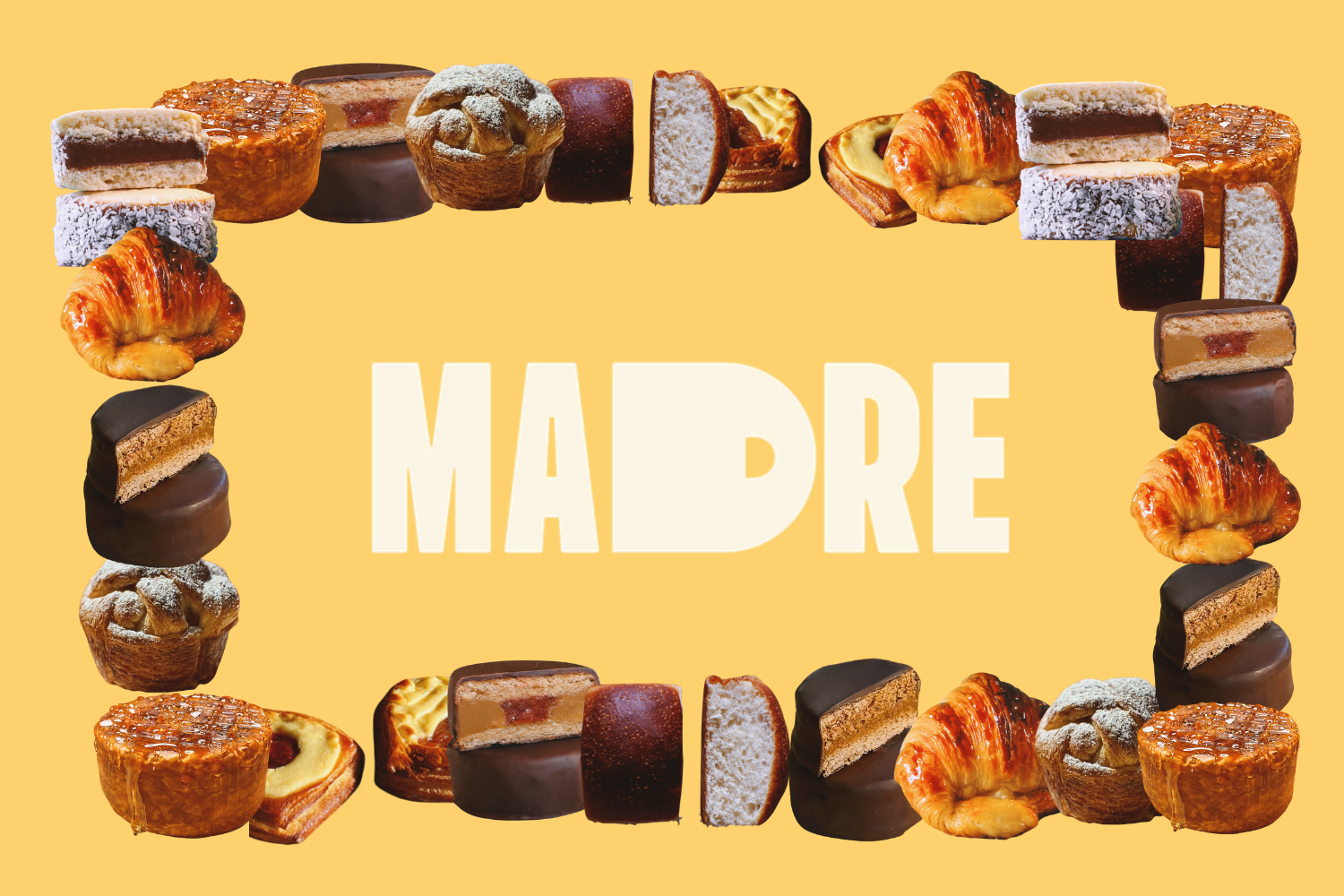
We spoke to Lelu and Vicky, the founders of Madre, whose humble medialuna has become a vehicle for a larger conversation about food, ritual, and community in urban life.
Sourdough starters, miso buns, and forced rhubarb danishes may once have sounded more like indie bands than bakery staples, yet across London and beyond, artisanal bakeries have spent the last decade mushrooming into corner plots and railway arches. With new data revealing that the number of independent bakers across the U.K. has grown by 34 percent in the last five years alone, it would be easy to assume the city has reached peak pastry. Every Sunday, at the Queen's Park Farmers' Market, however, Vicky and Lelu, founders of Madre, spend much of their time introducing Londoners to a pastry many have never encountered.
Customers approach their stall, glance at the crescent-shaped pastries, and ask a familiar question: Is it like a croissant? At first glance, the medialuna does indeed resemble a croissant. Its name translates literally as “half moon,” and its shape is similarly crescent-like. But ask any Argentinian and comparisons tend to end there. Softer, sweeter, and glazed rather than shatteringly laminated, it occupies a place in Argentine culture on par with Maradona and the tango. “If we're talking about taste, we think it's probably what heaven might taste like,” says Vicky. The French may need to cover their ears, but it would be hard to disagree.
Where a croissant fractures into a shower of flakes, the medialuna yields softly. Its crumb pulls apart in delicate strands, while a light glaze leaves a lingering sweetness on the fingertips. In that sense, it mirrors Argentina itself: at a cursory glance reminiscent of Europe, yet when properly dissected something altogether distinct from anywhere else in the world. It was one of the main flavours they struggled to find after leaving Argentina behind. Vicky studied economics before relocating to the U.K. and moving into professional baking. Lelu worked in advertising strategy, eventually leaving a career that had become unsustainable.
“I didn't know I wanted to bake,” she says. “The main factor was a job that left my mental health in ruins. Vicky saw the spark I thought I had lost and fought to bring it back.” The pair began Madre partly as an exercise in homesickness, but what they missed was not just the pastry per se but everything surrounding it. “As we started thinking of Madre, we realised we were also craving community,” they explain. “In Argentina it's very common to gather around food. Good, delicious, effortless food. It doesn't matter the occasion, having something to nibble is a way to connect.”
That connection sits at the centre of Argentine bakery culture. From Buenos Aires to Córdoba, Rosario and beyond, facturas, as they are called in Argentina, are rarely purchased individually. Customers buy by the dozen, often arriving home with a paper box filled with assorted sweet breads and pastries intended for sharing. And whereas Europeans might bring along the bill to go Dutch, Argentinian facturas come with their own weight.
The story begins in the late nineteenth century, when Argentina's bakers organised under anarchist labour unions. As part of the movement, union members renamed baked goods to call attention to the value of their labour, their facturas. For anyone whose secondary-school Spanish remains intact, facturas indeed translates as “invoices.” The bakers used blasphemous monikers to target the institutions they believed stood in the way of individual freedom, turning pastries into bolas de fraile (friar's balls), suspiros de monja (nun's sighs), vigilantes (guards), cañones (cannons), and bombas (bombs). A century later, Argentinians still order revolutionary pastries alongside their morning coffee, often without a second thought.
Madre's own ambitions, however, are less confrontational. In an era increasingly defined by individual consumption, the act of buying a dozen pastries rather than one begins to look almost subversive. The contrast is one Vicky and Lelu encountered immediately after arriving in Britain. "In Argentina, when you go to the bakery you buy by quantity because things are meant to be shared," they explain. "Here, people tend to buy for themselves."
Instead of lamenting this cultural difference, Vicky and Lelu decided to forge their own sense of community, starting with their name. Madre means “mother” in Spanish, though not solely in the familial sense. “When we were naming the brand, we wanted something that reminded us of home — our motherland,” they explain. “It wasn't specifically a tribute to our mums, although we love them very much. Family, both the given and the chosen kind, is at the core of everything we do.” The recipes carry traces of that inheritance. Some originate from their own family kitchens in Argentina, and alongside medialunas sit focacetta, pebete bread, and alfajores, introducing customers to the broader tradition of Argentine baking.
Indeed, migration, they say, has sharpened rather than diluted their understanding of those flavours. “It made us love our food even more,” says Lelu. “There are things we took for granted that are now difficult to find. Whatever we make tries to resemble them, and when we don't figure them out, we keep trying until we do.” Their account of building Madre feels refreshingly free of influencer startup mythology. There are no grand declarations about disruption, just the conviction that food can create space for people to gather. “We do hope we can work as inspiration as well. Two women from Argentina, creating something from scratch just because we missed a pastry from home.” That belief may have just arrived at an opportune moment. London's bakery renaissance is often discussed in terms of craft, technique, and aesthetics.
Yet Vicky and Lelu suspect something deeper may be driving its popularity. Customers increasingly seek products with stories attached to them. For Madre, that story may have begun in Argentina but could only have been written in London. Future plans include a permanent home: a space both for selling pastries and for gathering around them. “A second home,” as they put it. The anarchist bakers may have imagined pastries as instruments of rebellion. Madre proposes a different kind of revolution. Not against church or state, but against isolation itself. And if that revolution begins with a half-moon-shaped pastry and a dozen shared among friends, there are certainly worse places to start.
Madre Bakery can be found every Sunday between 10 a.m. and 2 p.m. at Queen’s Park Farmers’ Market, Salusbury Primary School, Salusbury Road, London NW6 6RG.
Follow on Instagram @madrebakers
Order online at madrebakers.co.uk
This article originally appeared in Issue 06, published in May 2026. It was published online on September 24, 2026.