On the Spectacle of the Modern Wedding
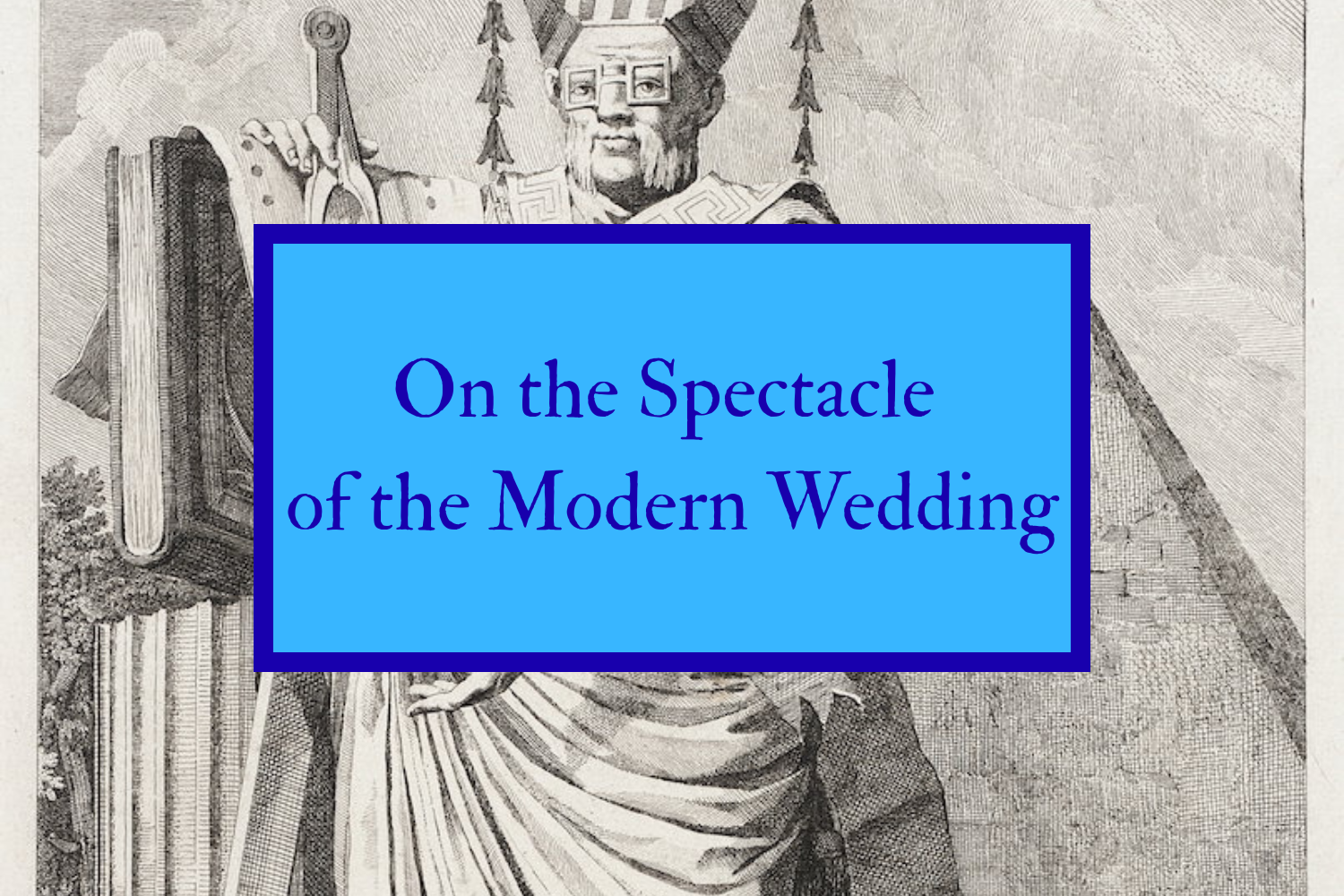
In the 1750s, the French artist and architect Ennemond Alexandre Petitot produced a series of satirical costume drawings known as Mascarade à la Grecque. Petitot was mocking the goût grec then sweeping French decorative culture: Society had become so consumed by style that people no longer merely wore fashion but disappeared into it. Sleeves terminated in Ionic scrolls. Shoes resembled masonry. Human bodies collapsed into pediments and pilasters. One woman appeared less dressed than upholstered by architecture itself.
Behold the modern wedding. Two and a half centuries later, post-millennial matrimony has reached much the same conclusion. Not through neoclassicism, perhaps, but through another aesthetic dialect entirely: candlelit vineyard dinners, “timeless” bridal silhouettes, drone footage drifting over Tuscan hills while the couple attempts spontaneity to the sound of an acoustic Lana Del Rey cover. The contemporary wedding transforms ordinary people into protagonists within a temporary visual order assembled from Pinterest boards, luxury hospitality branding, and the paralysing fear of appearing gauche.
And before anyone accuses me of cynicism, let me say plainly that I adore weddings. The modern wedding is one of the last socially acceptable forms of total theatre, and I am grateful for every second of it. I love the derangement of them. I love that otherwise emotionally constipated British adults will spend eleven months pretending not to care about table linen before collapsing into tears because somebody’s brother has played Fleetwood Mac slightly too sincerely beside a candelabra. I love that in an era where people can barely commit to a tenancy agreement, there remains one occasion upon which they willingly stand before a roomful of exes, frenemies, childhood acquaintances, and one aggressively divorced aunt to declare eternal devotion with full chest. But weddings have undeniably mutated.
Historically, marriage ceremonies functioned as communal rituals: legal, religious, and familial structures designed to place individuals inside an institution larger than themselves. The contemporary wedding often reverses this equation. Marriage now functions primarily as a vehicle for the expression of personal identity. The institution survives largely as aesthetic performance. This transformation is frequently blamed on social media, though it merely industrialised impulses that already existed. The deeper shift is harder to locate because it concerns perception itself.
This is the true paradox of the modern wedding: The more staged the event becomes, the more intensely it insists upon sincerity. Every floral arch, every custom monogram, every painfully expensive chair appears in service not of vanity but of emotional truth. The aesthetic labour must never appear aesthetic. Effortlessness itself becomes the most expensive effect of all. And perhaps this is why weddings remain difficult to mock too harshly, however absurd they become. Because beneath the drone footage and linen moodboards lies something unmistakably real: Contemporary people are desperately hungry for rituals capable of making life feel meaningful. In a secular and fragmented culture where stable institutions have largely dissolved, the wedding remains one of the last occasions upon which society collectively agrees that a moment deserves ceremony.
Many people today may never buy homes, remain in one city, belong to churches, or inherit stable communal identities. Friendships scatter geographically. Families become administratively complicated. Work colonises time once reserved for ritual. Adulthood itself increasingly arrives without recognisable thresholds. The wedding therefore swells to absorb impossible symbolic pressure. It must become permanence. It must become continuity. It must become evidence that a life, however unstable elsewhere, has briefly achieved coherent form.
And so couples spend extraordinary sums constructing temporary worlds in which beauty appears capable of stabilising reality itself. Sometimes, despite everything, it works. A father’s hand shaking during the speeches. Two friends who have not spoken in years embracing outside the toilets. The strange silence that occasionally descends upon a dance floor just before everyone begins singing the chorus together. Beneath all the orchestration, weddings still produce fleeting moments of genuine collective feeling, which is precisely why people continue submitting themselves to eighteen-month planning spreadsheets and the psychological warfare of bridesmaid group chats.
Petitot understood something essential about spectacle: Human beings repeatedly mistake aesthetic order for existential order. We continue, centuries later, to drape ourselves in the visual languages of our age, hoping style might elevate ordinary existence into significance. The modern wedding may indeed be financially ruinous, emotionally overproduced, and aesthetically indistinguishable from a luxury fragrance campaign directed by Nancy Meyers. It may transform intimacy into logistics and love into a species of branding. Yet beneath the candlelight and curated vulnerability lies an ancient and strangely touching human impulse: the desire to gather witnesses and insist — against statistics, against history, against the ordinary instability of human feeling — that something fragile might last forever.
This article originally appeared in Issue 05, published in May 2026. It was published online on July 17, 2026.