Joe Lyons
If you ask Joe Lyons who he’d share a stage with — living or dead — he reaches for the canon: The Cure, Jeff Buckley, Bowie. Then, almost immediately, he steps back. “I’d be way in the background though. Preferably offstage,” he says, laughing. It’s not self-deprecation so much as instinct.
The Australian-born singer, songwriter, multi-instrumentalist, and producer arrived in London over fifteen years ago on a short tour that stalled almost immediately, a job disappearing just as quickly. What remained was a direction, if not a plan. Slowly, the city made its case. “There’s an urgency and vibrancy about the place,” he says, “a pressure cooker for creativity, but also enough amazing things to offset the intensity.”
Before settling into his own project, Lyons moved through the industry in ways that rarely followed a straight line: tour managing, guitar teching across the U.K. and Europe, drifting between bands and studios.
Most recently, he played guitar with Baba Ali at Hermès Men’s Fashion Week, first in the cavernous shell of Hong Kong’s former Kai Tak airport, then inside Napoleon’s Palais Brongniart in Paris. Even the stage he might have feared most didn’t rattle him entirely. The O2 Arena in London — supporting The Libertines with his former band, Deadcuts — was an experience he describes as holding on for dear life. “The power of the huge PA there moves every molecule in your body,” he recalls. Terrifying, but transormative. It’s the kind of moment, he says, “that shapes how you think about performing from then on.” These weren’t small rooms or niche moments. Still, Lyons carries them with instinctive reserve, something close to diffidence. His restraint has become a signature, one that obscures just how much ground he’s already covered.
Yet despite his rich musical trajectory, Lyons’ move toward a solo project didn’t come from bravado. Vocal issues linked to Ehlers-Danlos Syndrome (a rare set of conditions that affect connective tissues, sometimes including those in the larynx) held him back from a solo career for years. Diagnosis, management, and a remarkable vocal coach opened a door he’d long thought closed. Behind it waited “First,” his debut single that arrived last summer. The song draws from someone once close to him who battled addiction, but it expands into something universal.
“I started writing with imagery, obfuscation, randomness, stream of consciousness, and non sequiturs,” he says.
“I want the listener to make their own path through the song. Each track should be its own ecosystem.”
Musically, it draws on post-punk and krautrock without leaning too heavily on either. Jagged guitars cut through dense synth layers, while the drums keep everything locked in place.
“In music and life, things rarely work out how you expect,” he says. “It’s more about how you pivot.”
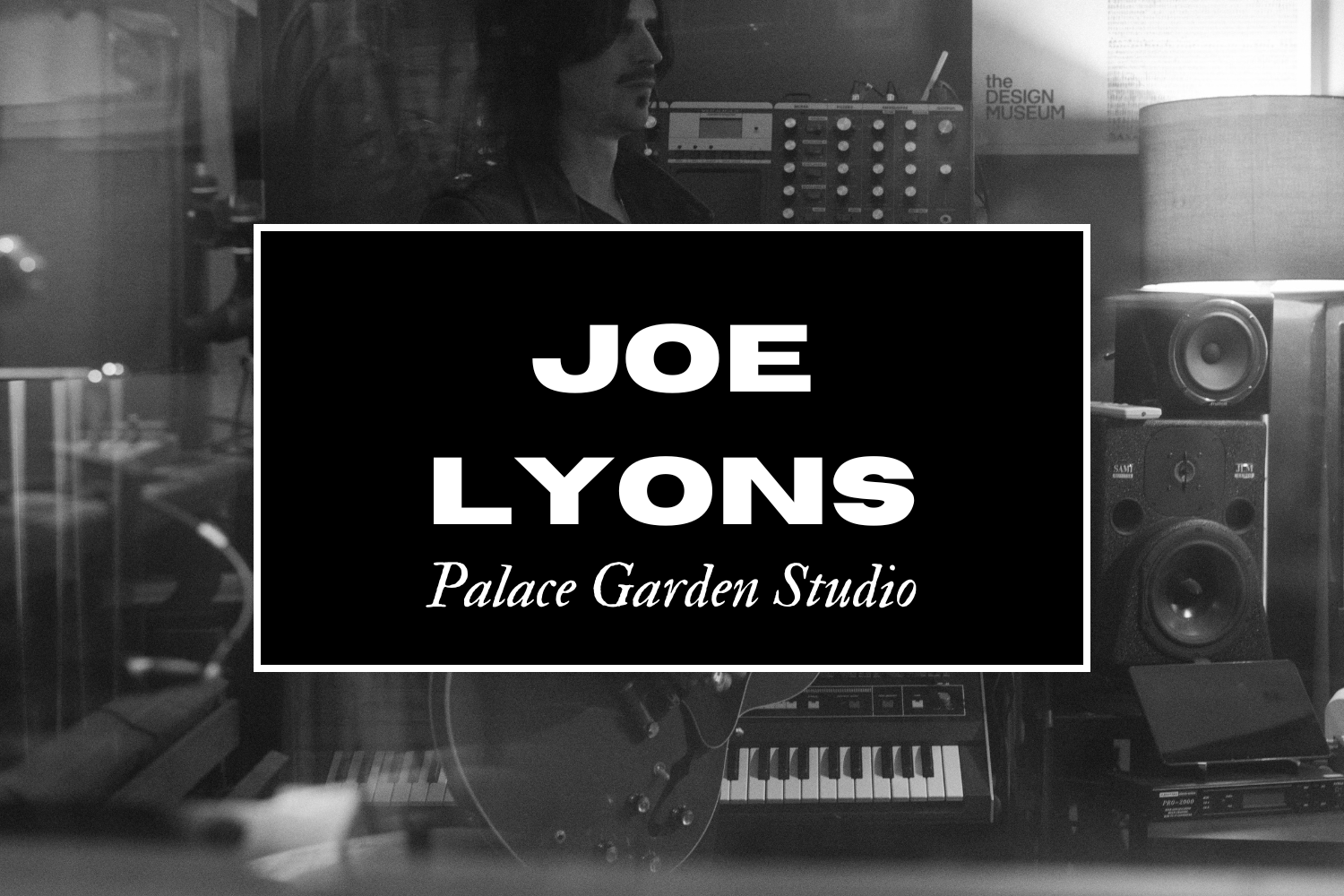
That same energy anchors itself in Palace Garden Studio, Lyons’ Limehouse-based creative hub, co-founded with two close friends. What began as a practical space to store gear and make noise without upsetting neighbours has grown into a full-fledged home for art. In a city reshaped by rising costs and constant redevelopment, Lyons is aware that spaces like it are increasingly rare. The building carries its own history — squats, fetish clubs, a long trail of previous lives. “It’s far from polished,” he says. “And in a city increasingly sanitised, that’s a good thing.”
For Lyons, the studio reflects his philosophy. When artists come through Palace Garden, he hopes they leave feeling fully empowered to express their vision. “Producers and engineers are meant to be in the service of art and the artist, rather than their own ego or personality,” he explains. The space has hosted a wide range of musicians, but for him it’s never been about genre. “I like the variety and challenge of working with all types of artists,” he says, “but it definitely helps if I like the music and the people involved.”
That attitude extends to the room itself. An upright Pleyel piano from the 1890s, left behind by a previous tenant, appears across much of the work made there. “It’s noisy and rickety,” Lyons says, “but it has so much character. It usually ends up on most tracks.”
He often tries to work with his eyes closed when producing or mixing, stepping back from the screen to stay connected to the physical and emotional shape of the music.
Even when it’s his own vision, Lyons doesn’t rush the reveal. “First” feels overdue not because he was behind schedule, but because it had to arrive when he could do it justice. It presents his personal threshold: the first step into a world he’s been building for years, now open for anyone willing to enter. The next single, “Cold,” is coming in May, with shows soon after.
And London? It continues to influence him. Lyons speaks of the city as one might of a person: capricious, inspiring, occasionally cruel, yet always vital. The Thames near his studio has its own rhythm; pubs and cafés, their distinct cadences. He is especially grateful to London’s music scene: The George Tavern is a personal favorite, as are the Shacklewell Arms, Paper Dress Vintage, Moth Club, Bush Hall, and countless others. And if, in its infinite moods, the city hurls a little chaos his way, Lyons has learned that sometimes the pressure cooker is exactly where the improbable emerges.
Follow Joe on Instagram or check out Palace Garden Studio here.
This article originally appeared in Issue 04, published in April 2026. It was published online on June 17, 2026.